
Part 1: The High Level Vision
Welcome to the first in a new series of articles we’ll be posting throughout 2026 as we build up to the launch of Lawn Mowing Simulator 2! As the name implies, we wanted to throw a bit of a light on how we here at Skyhook Games go about the process of making a videogame.
Our hope is that it’s at least interesting to read – for those in the industry it could be useful to compare notes, and for readers just interested in how games are made, hopefully it will be a nice insight!
While we will use our own history, work and practices as a basis for this series, we will try to cover off things that are common in indie game development even if we don’t necessarily use them – and who knows, maybe we’ll even persuade some friends in other cool teams to answer a few questions along the way!
Kicking it Off!
First in the series is the HLV – the High Level Vision. This is really where the idea of a game starts for us, a chance to pull together the ‘big picture’ and think about what we want the game to be at the top level.
Game Director Rick Payne, who has been with Skyhook Games for X years and was lead designer of the original Lawn Mowing Simulator game, explains: “It’s a precursor document to a Game Design Document (GDD) that is created at the start of a game’s concept phase. It can be considered something like an extended concept deck/document.”
Generally the HLV sets up the game pillars, then – in other words it sets out what the key concepts of the game are used to inform the games’ design and themes. But it’s not just that – it’s also about thinking through the experience the player will have.
“It also features a player story to help people visualise playing the game, and then proceeds to chronicle each area of the game and the key features within, and what the aim is for those areas.”
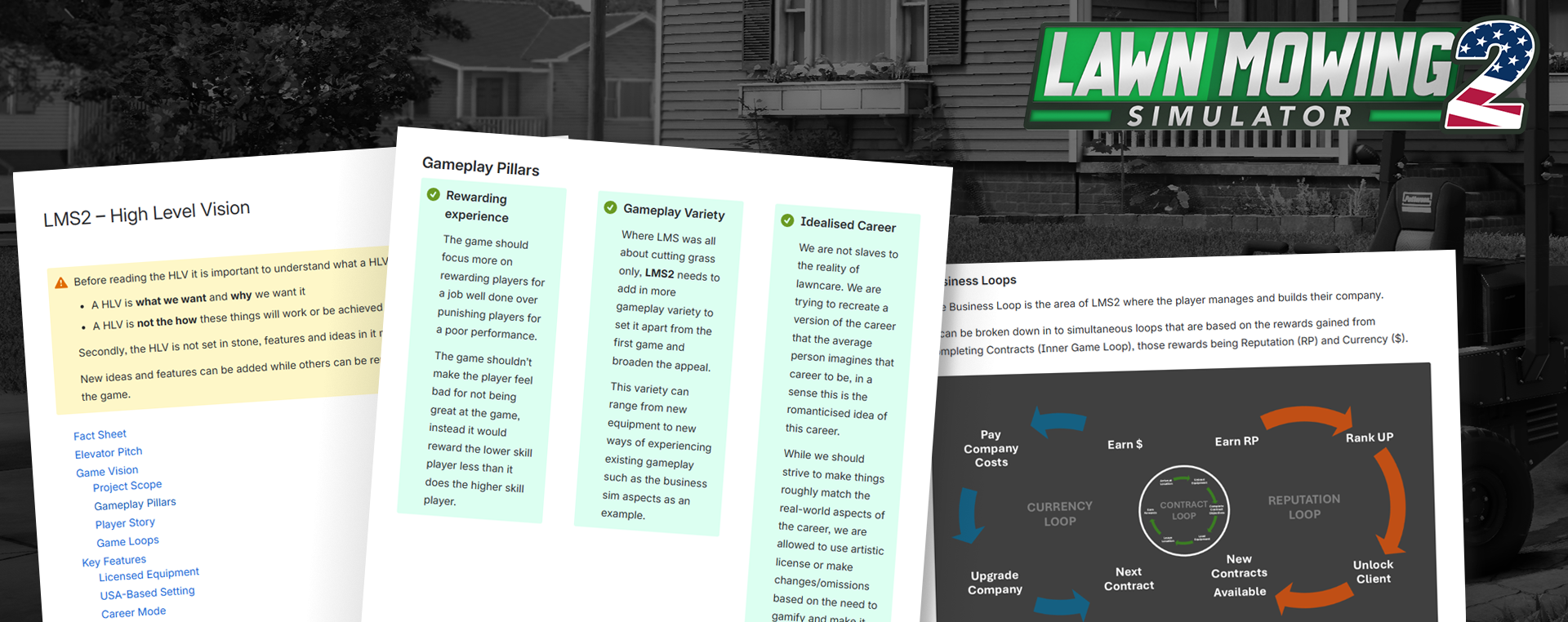
Image: The HLV is home to a lot of information, including the gameplay pillars as well as progression loops that help to visualise the player’s journey through the game.
HLV vs GDD?
But if the HLV and GDD are both big documents that aim to lay out the vision and experience for the game’s development and features, how do the two differ?
“The HLV keeps the detail of how everything works to a minimum,” explains Rick, “focusing on the key high level aspects of each feature and not the minute detail. The HLV shows what is wanted in the game and why it is wanted, whereas the GDD breaks down each mechanic and feature into its smallest parts and charts how these all interact.”
Or, in summary: “If the HLV is a preview of the game, the GDD is the manual that describes how to make it.”
Taking the Time
While it might be tempting to jump right into the action and start writing code, creating 3D models, and so on, it’s important to spend the time at the beginning to get the direction right – but how much time does this phase take?
As with most things, this will depend on a number of factors, such as how big or complex the game is overall, as well as how much of the general vision for the game is known and understood by the team as a whole.
Since Lawn Mowing Simulator 2 is a sequel, even though pretty much everything is being redesigned and rebuilt from scratch, a lot of the original game’s concepts still stand. When creating a completely new project, making sure that key team members all have the same understanding about the game’s vision can take a little longer.
“The LMS2 HLV took a few weeks to create, which covered multiple passes of the documentation and many meetings with the team’s department heads to discuss features and wants,” explains Rick.
And, he adds, it’s important that the HLV isn’t consigned to history once work begins on the next stage. “The HLV is a living document, which means that as development and planning both progress, the HLV may need to change with what the team finds out and learns.”
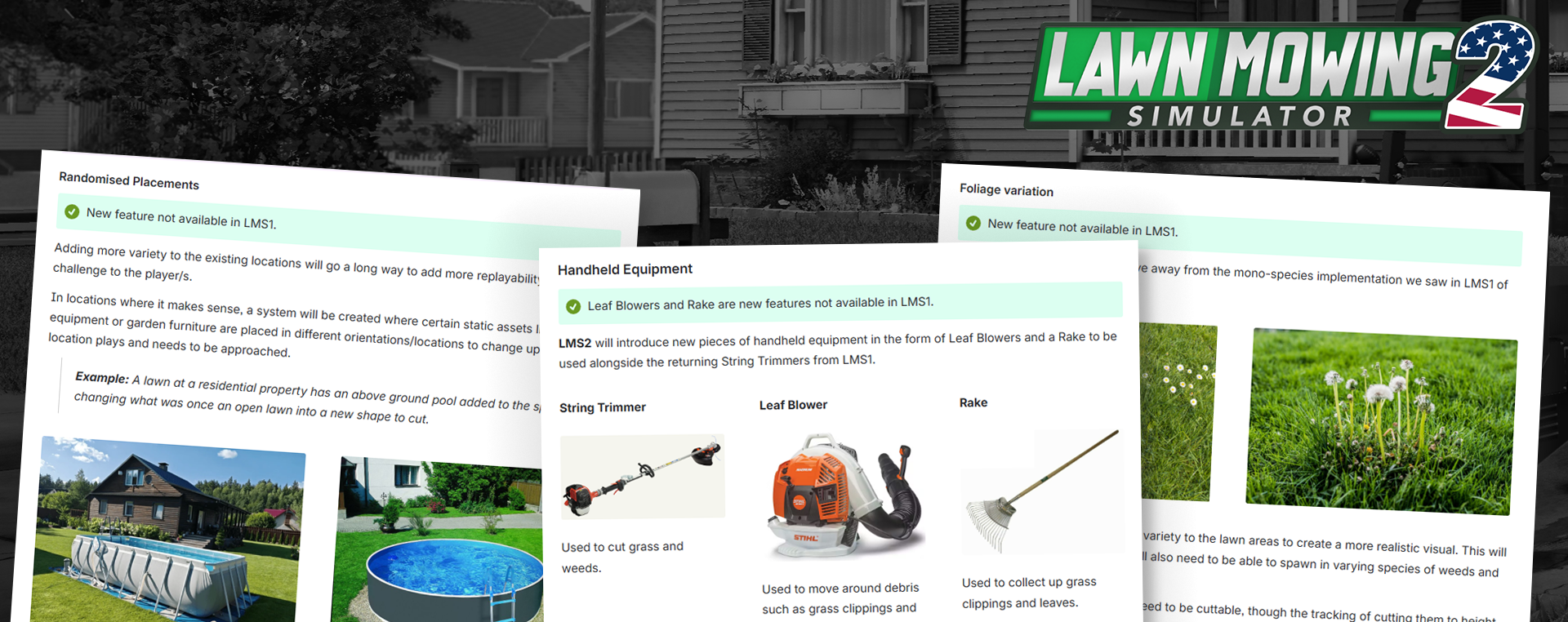
Image: Listing out new features and equipment help to establish a consistent understanding of what the game is trying to achieve
Doing the Work!
Normally, responsibility for creating the actual HLV document can be shared between a few people, but overall the whole team needs to understand the content. For Skyhook Games Rick, as Game Director, is the final sign off – but it needs careful input from domain experts.
“It is key that the experts in the team in their specific areas are called upon to contribute answers and information to the respected areas,” Rick explains. “So the art department are called on to inform the Art Target section, for example, while technical aspects such as platform builds are discussed with the Tech Director and code team.
“Writing the HLV this way means that each department is sense-checking the aspects of the game’s vision that directly relate to them. And this in turn helps with understanding the risks and scope of the project early.”
Could it be Better?
One question we always try to ask, whenever we look at an element of the game creation process, is “How could we have done this better?” And of course, that’s not to point the finger of blame, but to try to learn and improve.
So what about the HLV for LMS2 then? Rick’s already been thinking of areas that might work even better next time around.
“While the content of the HLV is good in terms of what it tracks, the importance of each feature or piece of content could have been rated,” he muses. “Post HLV and a number of months into development we ran a ‘MoSCoW’ (Must, Should, Could and Won’t) exercise across the project to highlight the most important aspects of the game.
“I think something along the lines of this could have been done as part of the HLV to help early on crystalise in planning what was the most important parts of the game to be focussed on.”
So that just about covers the High Level Vision – what it’s for, who creates it and how long it takes. Next time we’ll be looking at the Game Design Document (GDD) in more detail, so don’t forget to check back in the coming weeks!
You may know that we’re building up to the launch of our Kickstarter campaign for Lawn Mowing Simulator 2! Click here to check out our pre-launch page!
